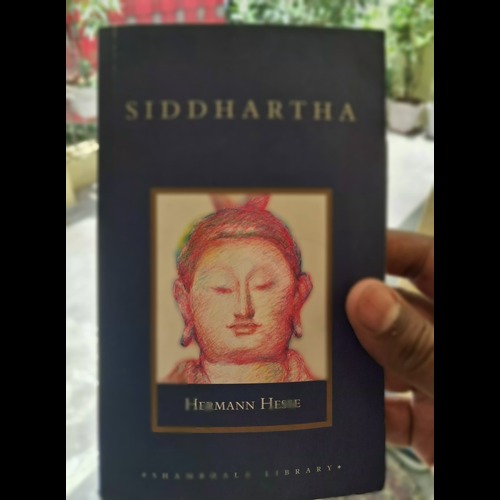
Speaking of a quintessential Indian novel, strangely, it doesn’t come from an Indian author. It comes from Hermann Hesse, a German author. The author’s grandfather was an Indologist with a deep interest in Indian culture. No wonder Hesse got Upanishadic knowledge as a family legacy. But this novel is not only an analysis of what Upanishads are. It goes into questions about the purpose of life. Although it is a short novel of about 150 pages which only qualifies it for a novella, the depth of questions raised makes it feel like it is very lengthy. Surely, no one really ponders over them when one is going through day-to-day living.
The youth today can easily relate to the novel Siddharatha by Hermann Hesse. Even though it has been set in ancient India. The main protagonist of the novel Siddharatha is going through turmoil. He is rather confused about what actually is the truth. Whether the rituals we perform have any meaning to it. Or, they are just a show-off.
His friend, Govinda has a firm belief that the ideal life of a person shouldn’t be materialistic. He is more steadfast with meditation. Siddharatha, on the other hand, has got serious doubts. Sidharatha doesn’t believe in what he thinks. He gets enamoured by lofty ideals and feels disillusioned by all of them.
With an aim to join ascetics, he leaves his house. Even though his father tries to restrain him, he doesn’t stop. The novel is a reminder that the road to self-realization is only ridden by obstacles. And the real obstacles are those that are hidden. They only become apparent when we get too involved in material life.
We always use the best of our abilities to earn money. We don’t care to invest it in doing good for others. The same thing happens with Siddharatha. He accumulates wealth just to satisfy his own desires.
Hesse draws a parallel from the story of Buddha who left his kingdom to attain nirvana only after he finds that there is no escape from death, old age and sickness. Siddharatha when he learns that the person who is revered by people is on his deathbed, he gives up the pursuit of wealth and starts introspection. This introspection leads him to self-realization.
Novel’s Structure
Hesse’s novel is bildungsroman or ‘coming of age’ story of Siddharatha. How Siddharatha matures into a personality who is humbler and more receptive. As a youth Siddharatha got impressed easily by learning and as he progresses, he realizes that learning is not everything. You have to practice it in real life.
The novel flows elegantly like a movie. Every sentence is meaningful. Not a single word seems to be out of place. It speaks a lot about the clarity Hesse had about Indian culture as well as human psychology.
Siddharatha is like lyrical prose. At some points, you feel that you are not reading a novel. In fact, at some points the prose is so lyrical, it seems you are reading a poem.
Siddharatha: Relevance For Today’s Youth
How relevant is Siddharatha in current times. It is very much relevant because today’s youth get misled easily. There is so much to influence them. Social media, OTT platforms and social media to name a few. Siddharatha also tries to find a teacher or a Guru. At a young age, he is very impressionable. He joins ascetics or Shramanas. Then he satisfies his lust. But he is overwhelmed by the news that Gotama is about to pass away.
This news is a jolt for Siddharatha who is now doing real introspection. He discards his luxurious life and joins a ferryman. The ferryman teaches him some of the most important lessons of life. Vasudeva is the name of ferryman. Siddharatha lives with Vasudeva in his hut.
Even though Vasudeva is illiterate, he has become receptive to the ideas of Vasudeva. The ferryman teaches him that we should learn from rivers. So, you can look for answers to your doubts in a river. It seems Vasudev, the ferryman suggested that Siddharatha should do a deep introspection.
In the end, Govinda, Siddharatha’s childhood friend, Govinda considers Siddharatha a learned man. Learning need not come from manuscripts and Gurus. Even simple people can teach a lot if we are humble enough. Vasudeva is a ferryman without any learning. Yet he is the one who teaches Siddharatha the most profound lessons of life.
Mid-life Crisis Happens Sooner or Later
Like Siddharatha, we also get trapped into grinding pattern of day-to-day living. Then some of us experience a midlife crisis. The toxic work culture and pursuit of material success force us to rethink the importance of all these things. This might happen as soon as you’re 30 or as late as you’re 80. A balance is needed to ensure these pursuits don’t make our lives meaningless.
Conclusion:
Perhaps, Hesse imagined Siddharth to be an alter-ego of Gotama. Gotama is the exalted one in the novel. On the other hand, Siddharatha has all the qualities of the exalted one. But yet he gets trapped into the material life. There are many Siddharathas around us. They all possess the qualities of the exalted one. It is just that they are going in the wrong direction.