Mantras hold a unique place in Oriental religions, which have their origin in the Indian sub-continent. Buddhism or Jainism considers them as a way to connect with the higher self. They are supposed to bring inner calm and peace.
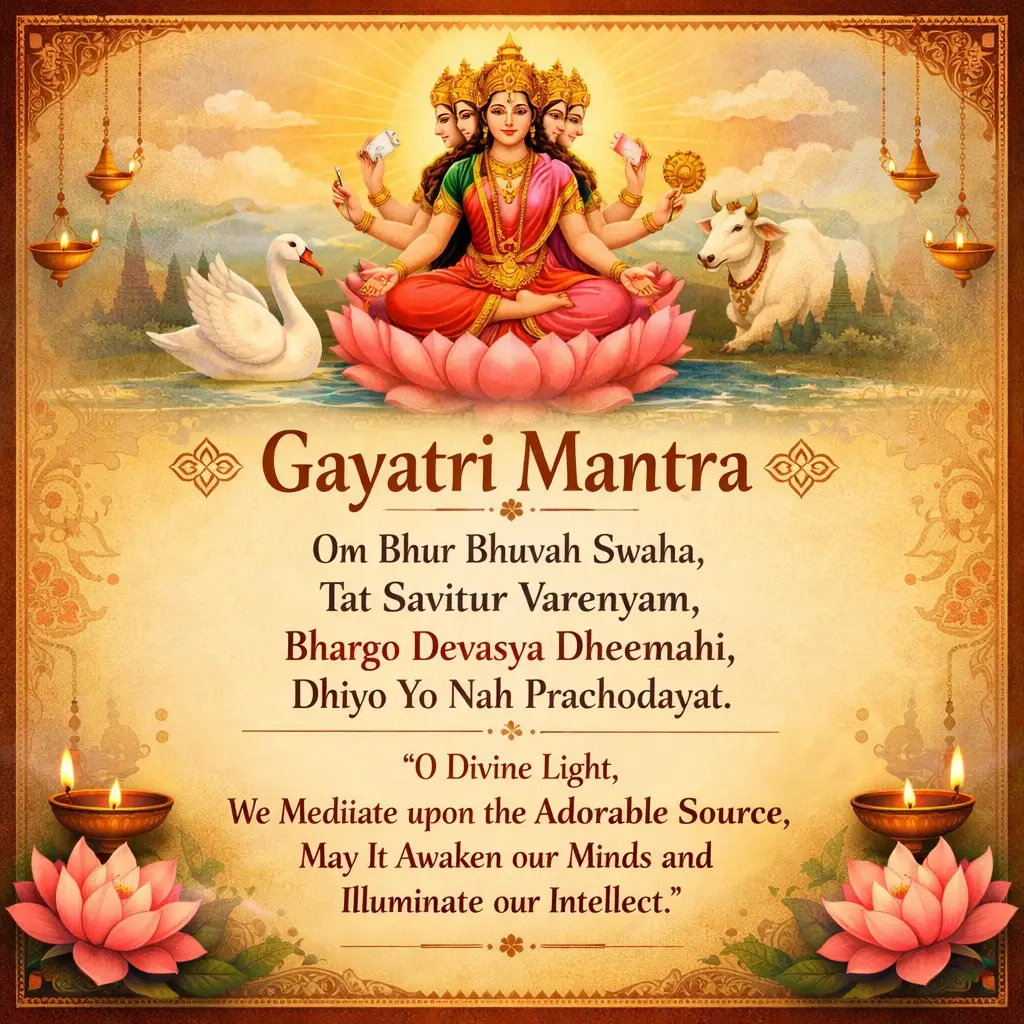
However, Gayatri Mantra holds a special significance for Hindus. This mantra is enshrined in the oldest Hindu scripture, Rig Veda. The fact that the mantra has been part of our age-old culture adds to its importance. But there are many mysterious aspects of this holy mantra that continue to perplex devotees and Hindu practitioners. In this blog we will explore some lesser-known aspects of Gayatri Mantra.
Respect among all sects of Hinduism for Gayatri Mantra
The shloka invokes Savitr, the divine source associated with Sun-like God, to offer us clarity of thought. So the Mantra is equally significant to both practitioners who say that God is personified and those who say that God is non-dual or formless. So, Gayatri Mantra is respected by non-dualistic believers who say that God doesn’t manifest himself in human form and Dvaita Vadis or dualistic thinkers who believe that God is personified.
Bhakti saints who are Dvaitvadi pushed practitioners to renounce material pursuits. Newly initiated practitioners are advised to repeat the shloka several times a day. The mantra helps in developing detachment from worldly things.
A few syllables of the Mantra encourage practitioners to focus on meditation. The syllables ‘bhargo devasya dhimahi’ stress the importance of meditative contemplation.
Advaitvadis like Adi Shankaracharya and Swami Vivekananda were also inspired by Gayatri Mantra. Since Advaitvadis advocated analysis of Vedanta, they recited the Mantra to develop their intellect. ‘Dhiyo yonah prachodayat’ are the syllables which draw our attention towards. A sound intellect would have helped Advaitvadis understand the Vedantic concepts.
But Bhakti school was more into developing dispassion towards worldly aspects or Vairagya. So, in a way Gayatri mantra inspired them also. Gaudiya Vaishnavas, followers of a Vaishnava sampradaya, who consider Sri Krishna as the supreme personality of Godhead recite the holy verse several times a day.
Efficacy of Gayatri Mantra
Mantras are said to have a transformative effect on the chanters. The RigVedic verse also bears such results. Even though mantras hold powers, their real impact can be experienced only when a Guru confers the mantra to a student. Self-realised Gurus offer the Mantra to practitioners who are newly initiated.
So, if an Advaitvadi Guru initiates a practitioner, the Mantra may increase the intellect of the practitioner. On the other hand, if a Dvaitvadi Guru initiates a practitioner with the Mantra, it may increase Vairagya or dispassion towards worldly desires.
Reference of Gayatri Mantra in all Hindu sacred texts
Curiously, Gayatri Mantra has been mentioned in several Hindu texts. Take a look at the texts which consider the verse sublime.
• Upanishads which are Vedantic texts provides interpretations of Gayatri Mantra.
• Chandogya Upanishad identifies Gayatri with the cosmic principle that sustains all existence. It describes Gayatri as the essence of speech, life, and creation itself.
• Brihadaranyaka Upanishad associates Gayatri with the vital force that protects and nurtures the universe. Through these teachings, the Upanishads elevate Gayatri from a mere hymn to a symbol of ultimate reality and spiritual knowledge.
• Bhagavad Gita also highlights the significance of Gayatri. In Chapter 10, Verse 35, Lord Krishna declares, “Among the meters, I am the Gayatri.” This statement emphasizes the supreme status of Gayatri among all Vedic hymns and poetic meters. By identifying Himself with Gayatri, Krishna underscores its divine nature and spiritual excellence.
• The Puranas contain numerous references praising the Gayatri Mantra. The Padma Purana, Skanda Purana, and Agni Purana describe Gayatri as the Mother of the Vedas and the embodiment of divine wisdom. These texts state that regular recitation of the mantra purifies the mind, removes sins, and leads the devotee toward liberation. The Puranic literature often personifies Gayatri as a goddess who grants spiritual and moral strength.
• Manusmriti and various Dharmashastras prescribe the daily recitation of the Gayatri Mantra, particularly during Sandhyavandana, the ritual performed at dawn, noon, and dusk. These texts consider Gayatri recitation essential for spiritual discipline, self-purification, and the cultivation of higher consciousness.
Conclusion
Gayatri mantra is held in high respect among all branches of Hinduism. But the mantra will bear its true impact only if its received from a self-realised Guru. Usually, the mantra is whispered by the Guru to a disciple when he or she is initiated. There can be multifarious impacts of Gayatri Mantra. The impact will depend on who is initiating the disciple. If the Guru is a self-realised impersonal Guru, it may enhance the intellect of the initiated. And if the Guru is a self-realised Bhakti saint, the mantra may bring dispassion in the initiated disciple.